 Home
Home
8/3/2026 • 5 min • Informational
Google AI Search Is Changing SEO: What Every Digital Marketer Must Learn
Read more
By Beegains Academy
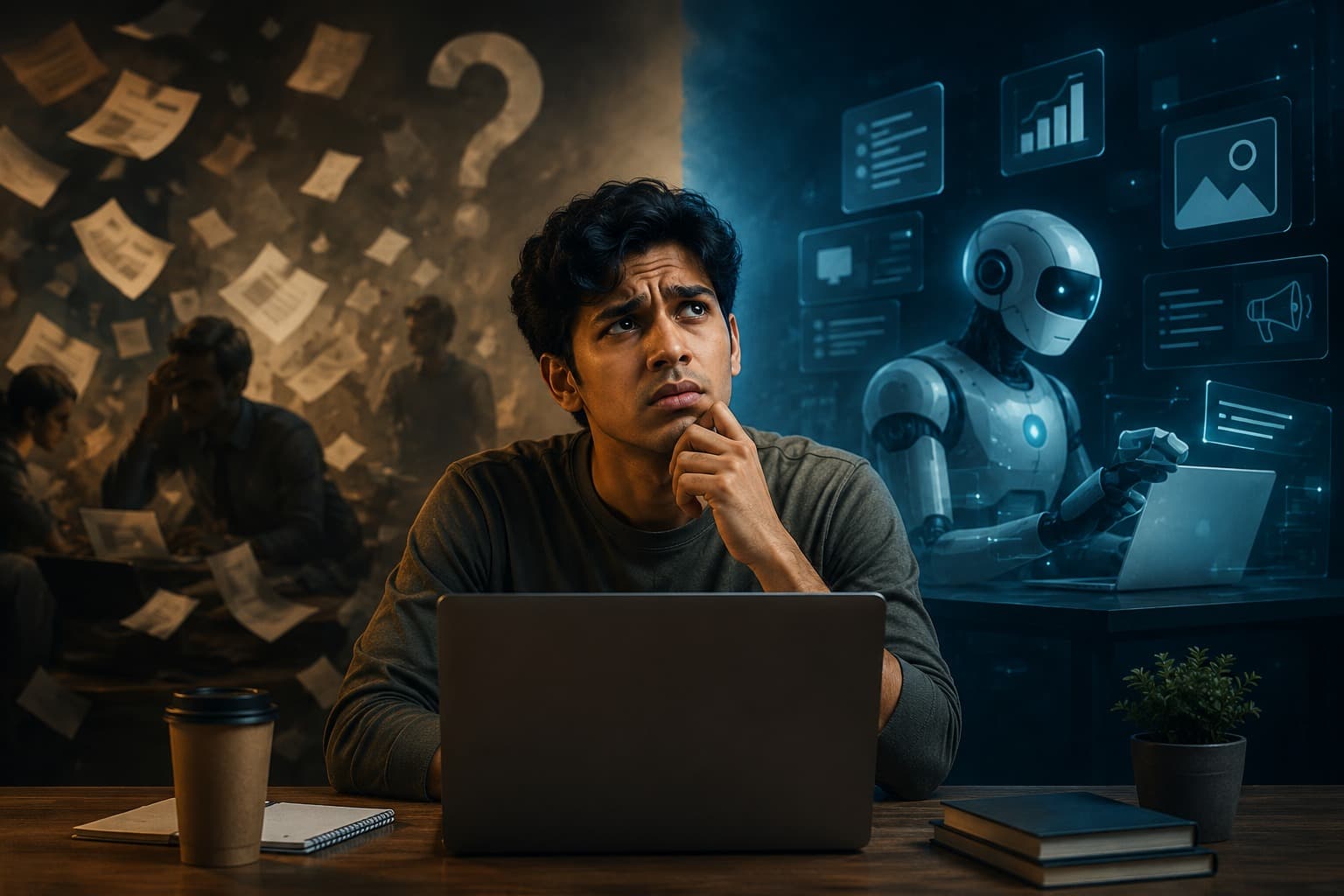
There's a question that keeps coming up in classrooms, in WhatsApp groups, in the comment sections of every marketing video that goes viral these days.
"Is there even a point in learning digital marketing anymore?"
It usually surfaces right after someone sees a demo of an AI tool writing a full ad campaign in thirty seconds, or generating a month's worth of social media content before lunch. And honestly, it's not a ridiculous question. It's the kind of question that deserves a real answer — not the dismissive "don't worry, AI can't replace creativity!" line that people throw out to end the conversation, and not the doomsday prediction either.
So let's actually think it through.
AI for digital marketing is not coming. It's already here, and it has been for a while now.
The tools professionals use daily — Google's Performance Max, Meta's Advantage+ advertising system, Surfer SEO, Jasper, ChatGPT — these aren't experimental curiosities. They're running live campaigns, writing ad copy, generating content briefs, and automatically adjusting bidding strategies for brands spending millions of dollars every month. Midjourney produces scroll-stopping visuals in seconds. Predictive analytics tools forecast customer behaviour before it happens. Chatbots handle thousands of customer conversations simultaneously without breaking a sweat.
This isn't speculation dressed up as a hot take. This is what marketing teams around the world are doing every single Tuesday morning.
So yes — AI is genuinely capable. It is getting better at a pace that is difficult to keep up with. And anyone who tells you otherwise is not paying attention.
But that's only half the picture. And the other half changes everything.
Here is where the conversation needs to get more specific, because "AI can do marketing" and "AI can replace marketers" are two completely different claims.
AI powered digital marketing tools are extraordinary at pattern recognition. They process vast amounts of data, find what has worked before, and optimise for more of the same at a speed no human could match. For repetitive, rules-based, execution-heavy work — resizing creatives, generating first drafts, running A/B tests, scheduling content, pulling reports — AI is faster, cheaper, and more consistent than a person doing the same task manually.
But here is what it genuinely cannot do.
It cannot understand the texture of a community. A campaign that resonates deeply with an audience in Kerala might fall completely flat for an audience in Karnataka, and not because of language — because of tone, cultural reference, shared experience, the way humour lands differently, the things a community finds aspirational versus tone-deaf. A marketer who belongs to that world carries that understanding naturally. No AI model does.
It cannot own a relationship. The kind of trust that makes a client call you first when a campaign is struggling, or back an unconventional idea because they believe in your judgment — that is built through conversations, through reliability over time, through being genuinely invested in someone else's success. That is not replicable.
It cannot think strategically in genuinely new territory. AI works within patterns that already exist. When a brand needs to reinvent itself, when a market shifts unexpectedly, when the brief is genuinely open-ended and the right answer isn't somewhere in the training data — that requires human judgment. The kind that draws on experience, intuition, and a real understanding of people.
And it cannot be accountable. Every marketing decision has consequences. For communities. For how people see themselves. For what a business stands for. Someone has to answer for those decisions. AI based digital marketing systems can flag a risk. They cannot carry responsibility for it.
Here is the mental model that makes sense of all of this.
Every wave of technology has eliminated tasks while simultaneously making the people doing the surrounding work more valuable. The spreadsheet didn't put accountants out of business. It eliminated the most tedious part of their work and freed them to spend more time on analysis, strategy, and client relationships. Search engines didn't make researchers redundant. They changed what researchers spend their time on.
AI for digital marketing is following the exact same pattern — just faster.
The marketers who are genuinely at risk right now are those whose entire professional value sits in the tasks AI now handles better and cheaper. Writing generic product descriptions. Manually formatting reports. Scheduling posts with no strategy behind them. These were never where the real value lived. They were the entry-level grunt work that used to be the price of admission. That price has dropped to zero.
The marketers who are thriving are those who have moved up the value chain. They use AI the way a skilled professional uses better equipment — to produce more, faster, at a higher standard. An AI powered digital marketing workflow today lets a single person do what used to require a team of three or four. But what they produce is still guided by their judgment, shaped by their strategy, and delivered through relationships that no tool can replicate.
The transition isn't from "marketer" to "no marketer." It's from "marketer who executes manually" to "marketer who thinks strategically and executes at scale."
So practically speaking — what should you be developing?
Strategic thinking is the foundation. The ability to genuinely understand a brand, identify where the real opportunity is for that specific audience, and design a campaign that connects those things — this cannot be automated. AI can execute a strategy. It cannot create one born of actual human insight.
Data literacy matters more than it ever has. AI generates more data than any team can act on. The skill is not producing the dashboard. It's knowing which numbers actually matter, what they're telling you about real human behaviour, and what decision they should drive. That kind of interpretation is deeply human.
AI tool fluency is now a baseline requirement. Not a vague awareness that tools exist — genuine, hands-on understanding of which tools do what, how to use them well, how to prompt them effectively, and critically, where they go wrong. The marketer who can direct AI intelligently will always outperform the one who follows its output blindly.
Creative judgment is different from creative production. AI can produce a hundred ad variations in the time it takes you to drink your morning coffee. Knowing which one to run, why it will resonate with this specific audience, and how it fits into a bigger brand story — that requires taste and experience that comes from paying close attention to people for a long time.
Storytelling is irreplaceable. The ability to write in a voice that feels like a real person, to walk into a room and bring people along with an idea, to make someone feel something with a piece of content — these are human skills. AI based digital marketing can assist with the drafting. It cannot replace the person who actually has something real to say.
The barrier to entry has dropped. A skilled beginner today, armed with the right tools and genuine strategic thinking, can produce work that would have required a much larger team just five years ago.
But surface-level knowledge is worth less than it used to be. If your entire skillset is scheduling posts and following templates, you are competing with tools that do it for free, instantly, at scale. The edge comes from going deeper — building strategy instincts, developing real creative judgment, and learning to work with AI as an extension of your own thinking rather than a crutch that replaces it.
The right question for anyone considering this career path is not "will I have a job?" It's "am I building the kind of skills that make me genuinely hard to replace?" Those are very different questions, and only one of them is worth losing sleep over.
AI will not replace digital marketers.
It will replace the parts of the job that were always more administrative than strategic. It will make a certain kind of low-skill execution obsolete. And it will raise the standard for everyone who wants to do this work seriously.
For those who are curious, adaptive, and willing to keep developing — the opportunity in digital marketing right now is larger than it has ever been. Businesses are spending more, not less. New categories of marketing work are being created faster than old ones disappear. The demand for people who can think well, work creatively, and direct AI intelligently is growing every quarter.
The real question was never whether AI would arrive. It's already here. The question is whether you're building the skills to work alongside it — or waiting to be replaced by someone who is.
At Beegains Academy, our AI integrated digital marketing course is built specifically for this moment. We teach you the strategy, the creative thinking, and the tool fluency that make you genuinely valuable — not just employable, but excellent.
If you're in Malappuram or anywhere in Kerala and you're serious about a career in marketing, come learn where the industry is actually headed.
Explore the AI integrated digital marketing course at Beegains Academy →
Keep learning with our latest posts.


Address
396, 397, 398
MACHINGAL, DOWN HILL, MALAPPURAM,
Melmuri, Malappuram, Ernad,
Kerala, India, 676517
Phone
+91 75948 80000
Email ID
info@beegainsacademy.com
Copyright © 2025 by BEEGAINS All Rights Reserved